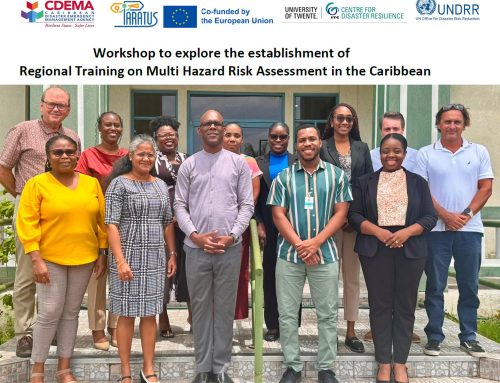


The Fourth Romanian Case Study Stakeholder Workshop is co-organised by the PARATUS team from the University of Bucharest, under the coordination of the Romanian Case Study leader, Prof. Dr. Iuliana Armaș, and the Department for Emergency Situations (DSU), under the coordination of Dr. and State Secretary Raed Arafat.
The morning session opens with an address by Gen. Dr. Marius Dogeanu (DSU). His speech will present DSU’s central role within Romania’s National Emergency Management System (SNMSU), its close collaboration with the General Inspectorate for Emergency Situations (IGSU), and its experience in managing multiple risks and complex interventions. The discourse also highlights the benefits of Romania’s participation in a European network for sharing best practices and response scenarios in disaster risk management.
The workshop begins with the Presentation of PARATUS Operational Applications for Emergency Management, the practical use of products and services available through the Disaster Risk Stakeholder Hub.
Dr Toma-Dănilă Dragoș held a hands-on session in which he introduced the workshop participants to the functionalities and ways to operate tools developed or used within the Paratus project, especially FastFlood, RiskChanges and OpenQuake. On the laptops provided by organisers, participants were able to run their own flood simulations. There was a lot of interest in testing adaptation measures such as levees, barriers, pumping stations, and flood-control reservoirs. The ability to test various configurations so quickly was considered a clear benefit, although some limitations in the results were acknowledged, especially given the limited resolution of the default digital elevation model included in FastFlood. Some participants tested and compared the simulation results with the reality experienced during a recent severe flood in Romania, specifically in the Broșteni area. This sparked useful discussions and further demonstrated the value of Paratus tools, as well as the need for better collection of real data to enable calibration and validation. In addition to showing interest in Paratus results for the Bucharest Case Study, participants also expressed interest in applying some of the less complex research tools in their practice. It is worth noting that most participants, from both DSU and IGSU, hold important decision-making positions within their institutions, which will help strengthen collaboration between academia (University of Bucharest) and stakeholders involved in risk reduction in Romania. The complexity of some tools (such as RiskChanges), limited staff expertise, and data-sharing restrictions at first-responder institutions in Romania were found to be factors that render collaboration with academia essential for continued collaboration.

In the second part of the workshop, Prof. Iuliana Armas introduced a self-developed AI Decision Tool: CAUSE — AI-Supported Causal Decision Support for Civil Protection
CAUSE is a decision-support system designed to help civil-protection professionals understand how the consequences of a disaster can propagate through an interconnected urban system. Its purpose is to transform complex scientific knowledge about hazards, vulnerabilities, infrastructure dependencies and cascading impacts into clear, traceable and operationally useful causal information.
CAUSE is built around Impact Chains, which represent relationships between hazards, exposed elements, vulnerabilities, capacities and impacts. Instead of treating a disaster as a collection of isolated consequences, the system follows the pathways through which an initial disturbance can generate secondary and cascading effects. For example, an earthquake may damage electrical infrastructure, disrupt communications or water supply, affect hospitals and emergency services, and progressively increase pressure on response capacity.
The central principle of CAUSE is that AI does not determine the causal analysis. The analytical authority remains the validated Impact Chain and the deterministic CAUSE engine. The role of CAUSE is to answer the operational question “Given the causal knowledge currently available, what can this disruption affect, how can its effects propagate through the system, and where could intervention matter?”
When an operator asks a question in natural language, for example, “What happens if electricity fails?”, “What can lead to hospital overload?” or “What are the consequences if an emergency-response unit becomes unavailable?”, the system identifies the relevant elements of the Impact Chain and traverses the validated causal network. The resulting causal pathways can then be translated by an optional AI layer into concise natural-language explanations.

This architecture creates a strict separation between scientific evidence, causal structure, computational analysis and AI interpretation. The AI cannot invent new causal links, probabilities, or consequences, nor can it modify the underlying Impact Chain. Every substantive conclusion remains traceable to the causal evidence encoded in the system. If the available Impact Chain does not support an answer, CAUSE reports this limitation instead without generating any unsupported explanation.
Users can control the depth of causal analysis. At the first level, CAUSE identifies direct consequences or causes. At greater depths, it follows progressively longer causal pathways where these exist in the network. This makes it possible to move from an immediate operational question toward the identification of cascading effects, systemic vulnerabilities, pressure on critical functions and supported intervention points.
In this way, CAUSE combines the explanatory strength of causal modelling with the accessibility of AI while preserving a fundamental requirement for high-stakes decision support: the evidence and causal model determine the answer; AI helps humans understand it.
The model was enthusiastically accepted by the participants testing its utility.
After lunch, the second part of the workshop continued with an introduction to the field application and dedicated tools, vulnerability-risk discussions at selected sites, and problem-solving solutions.
The workshop strengthened dissemination and exploitation of PARATUS results, facilitating their uptake by key Romanian emergency management institutions, reinforcing collaboration between researchers and practitioners, and demonstrated the operational relevance and practical applicability of the project’s outcomes.