As climate change continues to intensify the frequency and severity of hazards across the Caribbean, proactive disaster management is a necessity. Recently, the PARATUS project’s Caribbean Application Case Study took center stage through a series of pivotal regional workshops. By bringing together humanitarian organizations, academic institutions, and disaster management agencies, these events focused on two key pillars of disaster risk reduction: strengthening Multi-Hazard Risk Assessment (MHRA) capacities and pioneering Anticipatory Action.
Building Long-Term Capacity for Multi-Hazard Risk Assessments
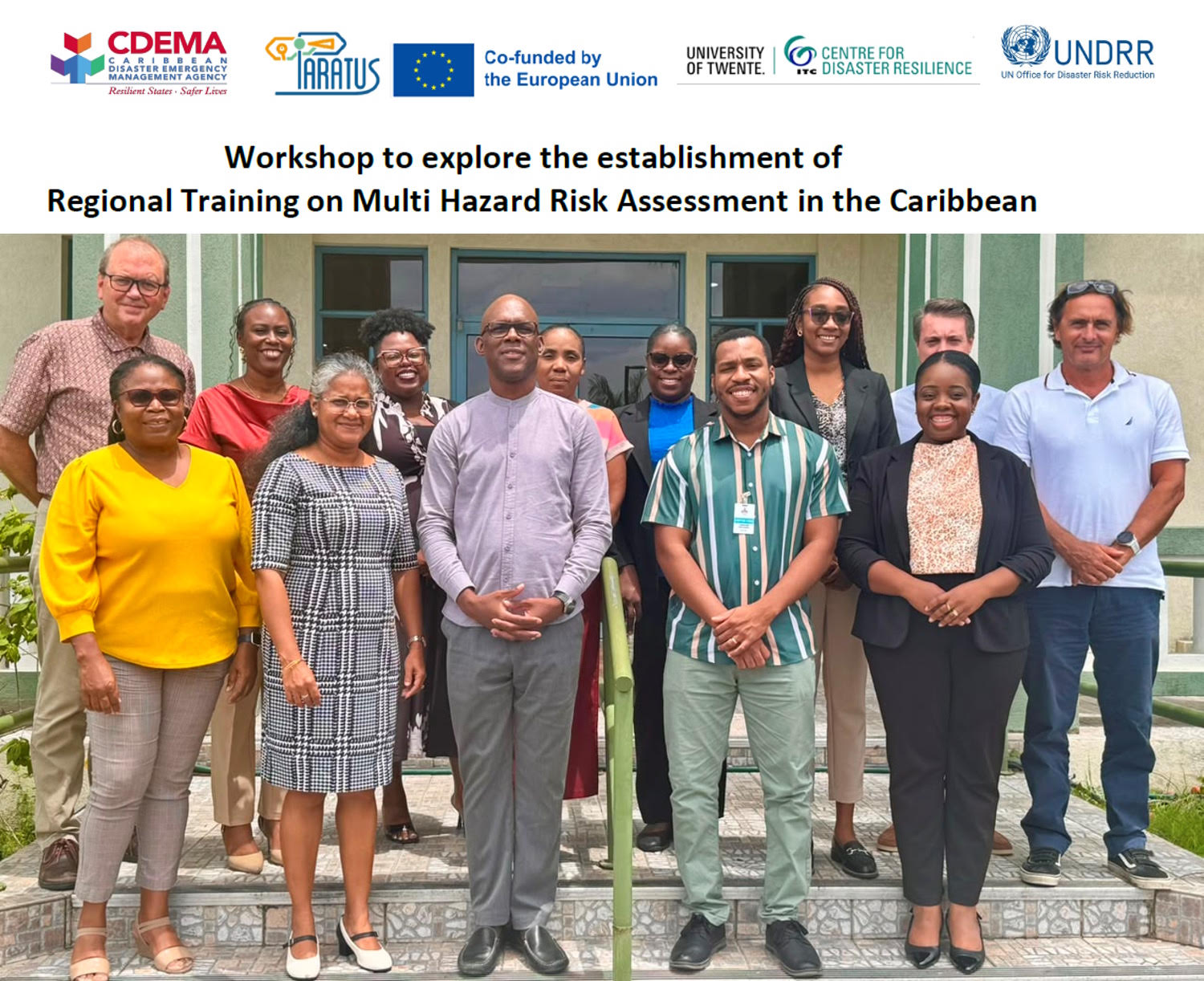
To effectively anticipate disasters, a region must first deeply understand its risks. Over two highly productive days at the University of the West Indies (UWI) Cave Hill Campus in Barbados, regional professionals gathered to explore how to strengthen long-term capacity for Multi-Hazard Risk Assessment (MHRA) in the Caribbean.
Convened by CDEMA, with support from the University of Twente, the UWI Disaster Risk Reduction Centre (DRRC), and UNDRR, the workshop focused on how Caribbean nations can develop the expertise needed to regularly produce and update risk assessments. Crucially, discussions also centered on how these assessments can directly inform impact-based forecasting, early warning systems, risk-informed planning, and climate adaptation.
A key message emerged from the Barbados workshop: the Caribbean already possesses substantial knowledge, experience, and training resources. The next great challenge is to consolidate these assets into a sustainable regional mechanism for professional training, firmly embedded within Caribbean institutions, to manage increasingly complex and interconnected risks.
Shifting from Reaction to Anticipation: Developing Early Action Protocols
In tandem with assessing risks, the region is taking concrete steps to act on them before disaster strikes. By 2030, climate-related losses could reach up to $580 billion globally per year, yet early warning and anticipatory action can reduce these impacts by up to 30%.
To operationalize this approach, the French Red Cross’ Regional Intervention Platform for the Americas and the Caribbean (PIRAC) hosted an Early Action Protocol (EAP) workshop in Guadeloupe from August 17th to 20th, 2026. This gathering brought together representatives from the National Red Cross Societies of Antigua and Barbuda, St. Kitts and Nevis, and Dominica, alongside PIRAC, 510 Global (Netherlands Red Cross), and the IFRC.
Recognizing their shared exposure to cyclones, these three nations have adopted an innovative sub-regional approach to design an EAP—a pre-agreed plan that automatically triggers specific, pre-funded humanitarian actions when a reliable forecast predicts a disaster. Built on clearly identified risks and pre-defined scientific thresholds, the EAP buys critical hours or days to evacuate, protect communities, and pre-position aid.
The Guadeloupe workshop, which built upon groundwork laid earlier this year in St. Martin, featured a simulation exercise designed to test activation processes and validate operational readiness across the Eastern Caribbean.
A Collaborative Framework for the Future
These combined capacity-building and anticipatory efforts highlight a profound shift in the Caribbean’s disaster management strategy: placing communities one step ahead of disasters rather than one step behind them.
The sub-regional EAP initiative, driven by PIRAC’s coordination and the collaborative spirit of the Caribbean Red Cross societies, is proudly supported by the European Union’s Horizon Europe programme under the PARATUS project, alongside the AFD – French Development Agency and the CMA-CGM Fondation.
By bridging the gap between multi-hazard risk assessment, scientific forecasting, and operational humanitarian action, the PARATUS project and its regional partners are ensuring that Caribbean nations are better equipped to foster long-term resilience in the face of climate-related threats.


